
You’ve probably started over more times than you’d like to admit. A new gym plan. Early mornings. Cutting back on your phone. Saving more money. The first week feels good, the second gets harder, and by week three most of it has quietly faded.
That isn’t because you’re lazy or lack willpower. In most cases, it’s because the plan was built to fail. You tried to change everything at once, you had no way of seeing your progress, and one bad day turned into a bad week.
This article sets out a simpler way to build discipline that lasts: a 90-day plan built on small daily actions, honest tracking and a clear way back after a slip.
Why most routines fail by week three
Before building something new, it helps to understand why the old attempts didn’t stick. There are usually three reasons.
1. You change everything at once. Motivation is high at the start, so you set five or six new habits on day one. That works while the motivation lasts. When it fades, which it always does, the whole plan collapses because it was built on a feeling, not a system.
2. You don’t track anything. Without a record, you’re relying on memory, and memory is a poor judge. A few good days feel like progress and one bad day feels like failure. You have no real picture of how you’re doing.
3. One bad day becomes a bad month. You miss a day, decide the streak is broken and think, “I’ll start again on Monday.” Monday becomes next month. The problem was never the missed day. It was not having a plan for what happens next.
Discipline isn’t about never failing. It’s about having a system that keeps you moving when motivation runs out.
Step 1: Start with an honest audit
Most men skip this step and jump straight to new habits. That’s a mistake. You can’t fix what you haven’t measured.
Take ten minutes and score these eight areas of your life from 1 to 10, based on where you honestly are today, not where you’d like to be:
- Body (energy, sleep, fitness)
- Mind and focus
- Money
- Career and skills
- Relationships
- Environment (home, desk, phone)
- Purpose
- Fun and recovery
Now look at your two lowest scores. That’s where to start. Not everywhere, just there. Improving the one or two areas that drag everything else down usually lifts the rest too.
FREE PRINTABLE
Get the 7-Day Discipline Starter
Try this system for one week before committing to 90 days. Score your life, pick 3 non-negotiables and track them for 7 days. 4 printable pages, A4 and US Letter.
Step 2: Pick 3–5 daily non-negotiables
A non-negotiable is a small action you do every day, no matter what, even on bad days. The key word is small. It should be easy enough that you could do it when you’re tired, busy or not in the mood.
Some examples:
- In bed by 23:00
- No phone for the first 30 minutes of the day
- A 10-minute walk
- Read 10 pages
- Plan tomorrow in 5 minutes before bed
- Check your spending
Pick three to five, linked to your two lowest audit scores. Then give each one a bad-day minimum: the smallest version that still counts. If your habit is “20 minutes of training”, your bad-day minimum might be “10 push-ups”. On your worst days you do the minimum, never zero.
This one idea removes most of the all-or-nothing thinking that kills routines.
Step 3: Follow three simple rules
Keep the rules simple enough to remember when things get hard.
Never miss twice. Missing one day is life. Missing two in a row is the start of a new habit, and not the one you want. If you slip, your only job is to get back on track the next day.
Small and done beats big and skipped. Ten push-ups you actually do are worth more than a hundred you planned and skipped. Consistency builds discipline; intensity on its own doesn’t.
Track honestly, not perfectly. A tracker full of ticks you didn’t earn is worthless. An honest 70% tells you exactly what to fix. The numbers are there to guide you, not to judge you.
Step 4: Track it in 5 minutes a day
Tracking is what turns good intentions into a system. It doesn’t need to be complicated. Once a day, take five minutes to:
- Tick off the non-negotiables you completed.
- Rate your energy from 1 to 5.
- Write down one win, however small.
Then, once a week, spend about 20 minutes reviewing. Which habit was strongest? Which was weakest, and why? What got in the way? What’s one thing you’ll change next week?
That weekly review is where the real progress happens. It’s how you spot patterns, such as late nights wrecking your mornings or a busy Wednesday that always breaks your streak, and fix them before they become reasons to quit.
Step 5: Work in three 30-day phases
Ninety days is long enough to build real habits and short enough to stay focused. Splitting it into three phases stops you from trying to do everything at once.
Phase 1 – Foundation (Days 1–30). Keep it simple. Your only goal is to show up for your three to five non-negotiables, even if that’s just the bad-day minimum. Build the habit of keeping your word to yourself.
Phase 2 – Momentum (Days 31–60). Now raise the standard slightly. Push a habit a little further, or remove a distraction that keeps getting in the way, such as your phone, late nights or something in your environment.
Phase 3 – Identity (Days 61–90). By now, the habits should feel more automatic. This phase is about becoming the kind of man who does this without thinking about it. Discipline stops being something you force and becomes part of who you are.
At the end of the 90 days, redo your audit and compare your scores. Seeing the change in black and white is one of the most motivating things you can do.
What to do after a bad day
You will have bad days. Everyone does. What matters is what happens next. When you slip:
- Don’t wait for Monday. Restart the next day.
- Do the bad-day minimum if that’s all you can manage.
- Write down what got in the way, without judging yourself.
- Plan one small change so it’s less likely to happen again.
A slip is information, not proof that you can’t do it.
A simple system to get started
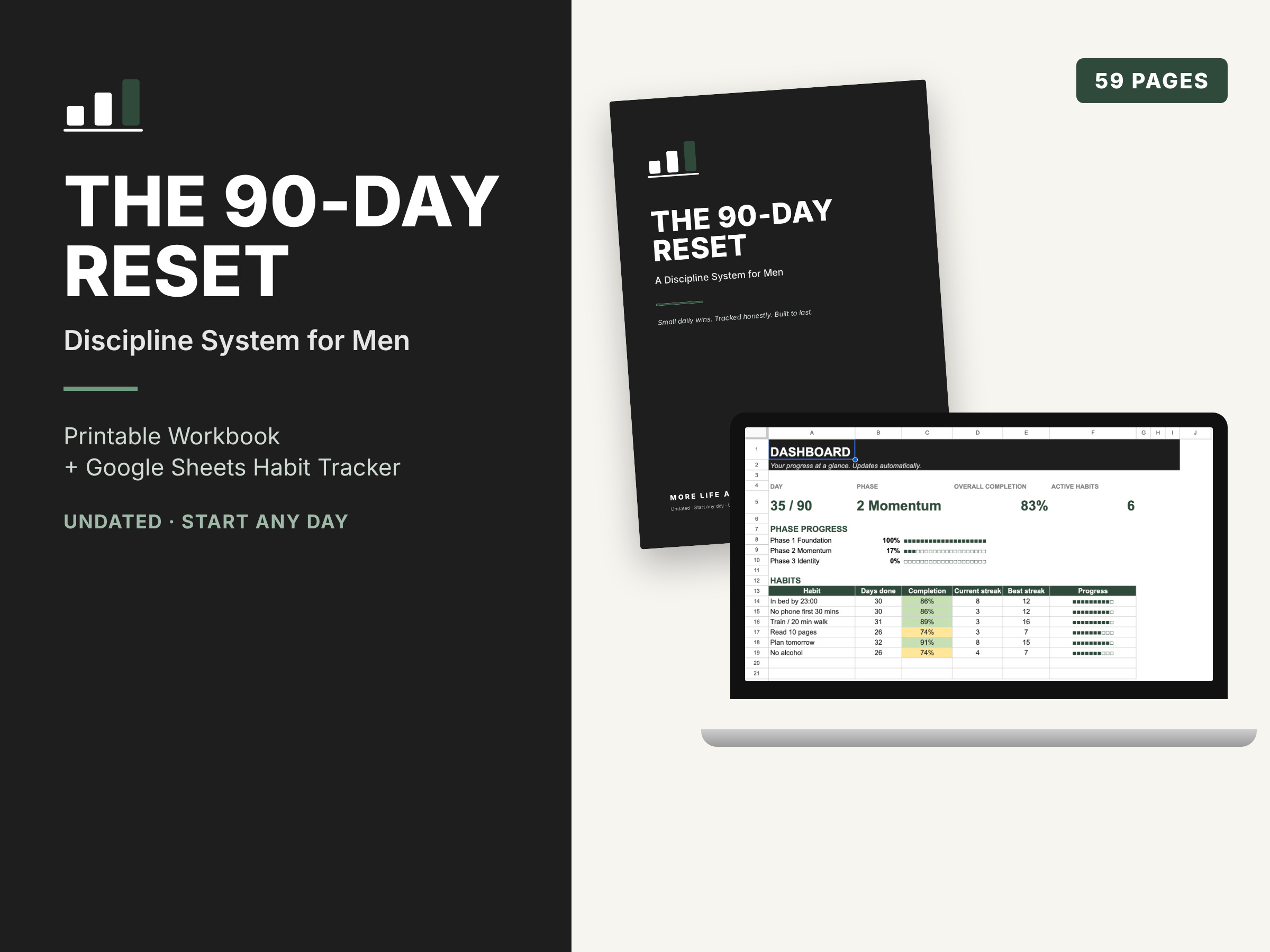
If you’d like this whole plan in one place, I put it together as The 90-Day Reset: a 59-page printable workbook with the audit, non-negotiables, weekly spreads and phase reviews, plus a Google Sheets habit tracker that works out your streaks and progress automatically. It’s undated, so you can start any day.
You don’t need it to follow the steps above. But if you want a ready-made structure instead of building your own, it’s there to make the next 90 days easier.
Final thoughts
Discipline isn’t a personality trait you either have or don’t. It’s a skill, and like any skill, it’s built through small, repeated actions over time.
Start with an honest look at where you are. Choose a few small non-negotiables. Track them honestly for five minutes a day. Never miss twice. Give it 90 days.
You don’t need to change everything. You just need to stop starting over.
This article is for general self-improvement and motivation. It isn't medical, psychological or financial advice. If you're starting a new exercise or diet routine, check with a qualified professional first.












0 Comments