
Payday comes in. A few days later the rent, council tax and phone bill have gone out. By the third week you’re checking your balance before buying lunch, wondering where it all went. Then payday arrives and it starts again.
If that sounds familiar, you don’t have a money problem. You have a system problem. You’re earning, you’re paying the bills, but nothing is telling your money where to go before it disappears.
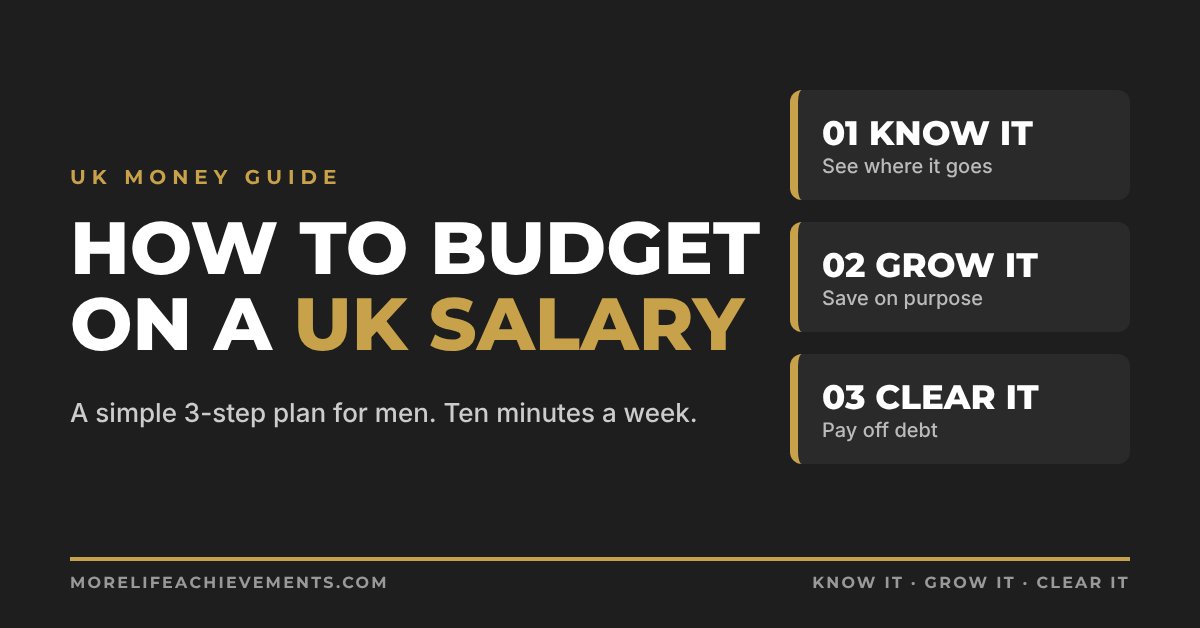
This guide sets out a simple way to budget on a UK salary in three steps: know it (where your money goes), grow it (saving for things that matter) and clear it (paying off what you owe). No complicated spreadsheets, no willpower marathons, just a routine that takes about ten minutes a week.
Before you start: budget on your take-home pay
The figure that matters is the money that actually lands in your account, not your salary. In the UK your take-home pay is what’s left after Income Tax, National Insurance, your workplace pension contribution and, if you have one, your student loan repayment.
You’ll find it on your payslip as “net pay”. If your income changes from month to month, because of overtime, commission or shifts, budget on your lowest typical month. Anything extra becomes a bonus you can put straight towards savings or debt.
Step 1: Know it – see exactly where your money goes
Most men guess what they spend. The guess is almost always too low. So before you plan anything, get the real picture. It takes about an hour, once.
1. List every bill
Go through your last two or three bank statements and write down every regular payment. In the UK that usually includes:
- Rent or mortgage
- Council tax
- Gas and electricity
- Water
- Broadband and mobile
- TV licence
- Car finance, insurance and road tax
- Gym, travel or season ticket
- Minimum payments on any debts
For anything paid yearly, such as car insurance or road tax if you pay it in one go, divide the cost by 12 so you can see the true monthly figure.
2. Do a subscription audit
Subscriptions are the silent leak. Streaming services, apps, memberships and free trials that quietly became paid. List every repeating payment and ask one question: did I actually use this last month? Cancel at least one you don’t. That money now has a job.
3. Give every pound a job
Now build your plan. The simplest approach is a zero-based budget: your income, minus bills, spending, savings and debt payments, should equal £0. Not because you spend everything, but because every pound is assigned before the month starts. Nothing drifts.
You may have heard of the 50/30/20 rule: 50% on needs, 30% on wants and 20% on savings and debt. It’s a useful starting point, but UK living costs, especially rent, often push needs well above 50%. That’s fine. It’s a guide, not a rule. Here’s an example of a zero-based budget on £2,400 a month take-home:
| Where it goes | Monthly |
|---|---|
| Bills – rent £850, council tax £145, energy £120, water £35, broadband £30, mobile £20, TV licence £15, car insurance £65, debt minimums £90 | £1,370 |
| Everyday spending – food shopping £220, fuel and travel £110, eating out £70, going out £60, clothes and personal care £50, fun money £50 | £560 |
| Future you – emergency fund £150, sinking funds £100, savings goal £70, extra debt payment £150 | £470 |
| Total | £2,400 |
| Left to assign | £0 |
In this example, needs come to about 70%, wants about 10% and “future you” about 20%. Your split will be different. What matters is that every pound has a place.
Don’t skip fun money. A budget with no room to enjoy anything gets abandoned in week two. Give yourself an amount you can spend without guilt.
4. Use a payday order
On payday, move money in this order: first make sure the bills are covered, then send your savings and extra debt payment, and only then is the rest yours to spend. Setting up standing orders for the day after payday makes this automatic.
THE SYSTEM, DONE FOR YOU
Men’s Money & Goals Tracker (UK)
A Google Sheets tracker that does the maths – monthly budget, savings goals, sinking funds and a debt payoff plan with your debt-free date – plus a 47-page printable workbook. Built for £, monthly payday and UK bills.
Step 2: Grow it – save on purpose
Saving “whatever’s left” doesn’t work, because there’s never anything left. Saving needs to happen first, and it needs a name.
Build a starter emergency fund first
Life throws things at you: the car fails its MOT, the boiler packs in, a phone breaks. Without a buffer, these go straight on a credit card and undo your progress. A common starting point is £500 to £1,000, or one month of essential bills. Pick what’s realistic for you and build it before anything else. Later, many people aim for three to six months of essential costs.
Set up sinking funds for the costs you can see coming
Many “surprise” bills aren’t surprises at all. You know Christmas is coming. You know the car needs an MOT. A sinking fund means saving a little each month so the money is there when the bill lands. Common UK sinking funds include:
- Car MOT and service
- Car or home insurance, if paid yearly
- Road tax, if paid yearly
- Christmas, birthdays and gifts
- Holidays
- Clothes and trainers
- Replacing your phone or laptop
The maths is simple: yearly cost ÷ 12 = what to save each month.
Name your goals
“Savings” is easy to raid. “House deposit”, “new car” or “Japan 2028” isn’t. Pick up to three goals, give each a target and a date, and work out the monthly amount: (target − what you’ve already saved) ÷ months to go. Many UK banks let you create separate savings pots or spaces, so each goal can have its own home, away from your spending money.
Step 3: Clear it – pay off debt one at a time
If you have debt, write every one down: the lender, the balance, the interest rate (APR) and the minimum payment. Credit cards, overdrafts, personal loans, car finance, buy now pay later and store cards all count. Seeing the total in one place is uncomfortable, but a number you know is a problem you can solve.
Then pay the minimum on everything and put every spare pound towards one debt at a time. There are two proven ways to choose which:
- Snowball – smallest balance first. Quick wins keep you motivated.
- Avalanche – highest interest rate first. Usually saves the most money overall.
When one debt is cleared, roll its payment into the next. The best method is the one you’ll stick to.
Two rules make this work. Build your starter emergency fund first, so one unexpected bill doesn’t push you back into debt. And take on no new debt while you’re clearing the old.
A note on student loans: UK student loans usually work differently from other debts. Repayments are taken through your pay once you earn above a threshold, based on your income rather than the balance, so most people leave them out of a payoff plan. The rules depend on your plan type, so check GOV.UK or your Student Loans Company account for your own details.
Make it stick: ten minutes a week
A budget only works if you look at it. Two short check-ins keep it alive:
- Weekly (10 minutes): log what you spent, check you’re on track and note one win and one leak.
- Monthly (30 minutes, on payday): compare plan with actual, adjust anything that isn’t working, and plan next month before it starts.
You’ll have a bad month. Everyone does. If you overspend, don’t scrap the budget. Take it from next month’s fun money, note what happened and carry on. Progress, not perfection. If building habits like this is the hard part for you, our guide on how to build discipline that actually lasts covers the routine side in more detail.
Common budgeting mistakes to avoid
- Budgeting on your gross salary instead of take-home pay
- Forgetting yearly bills like car insurance, road tax or Christmas
- Leaving no room for fun, then giving up
- Saving “whatever’s left” instead of paying yourself first
- Attacking debt before you have any emergency buffer
- Never looking at the plan again after day one
Frequently asked questions
What’s a good budget rule for the UK?
The 50/30/20 rule is a reasonable starting point, but rent and bills often take more than half of a UK salary. A zero-based budget, where every pound is assigned, tends to work better because it’s based on your real numbers.
How much should I save each month?
There’s no single right number. Start with whatever you can do consistently, even £25 a month, and build a starter emergency fund first. Consistency matters more than the amount at the beginning.
Should I save or pay off debt first?
Many people build a small emergency fund first, then focus on debt, so an unexpected bill doesn’t go back on a credit card. After that, you can split extra money between debt and savings goals.
If debt feels unmanageable
If you’re missing payments, being chased by lenders, or money worries are affecting your sleep or health, you don’t have to deal with it alone. These UK organisations offer free, confidential help: MoneyHelper, StepChange Debt Charity, National Debtline and Citizens Advice. Be wary of companies that charge for debt help when these services are free.
Want the whole system ready to go?
Everything in this guide is built into the Men’s Money & Goals Tracker (UK). You get a Google Sheets tracker with a 12-month budget that fills in your actual spending, savings goals and sinking funds that work out your monthly amounts, and a debt payoff planner that shows your attack order and estimated debt-free date. It comes with a 47-page printable workbook covering all three phases, and a Money Rules wall print.
You don’t need it to follow the steps above. But if you’d rather have the structure ready-made, it’s there to make it easier.
Final thoughts
Budgeting on a UK salary isn’t about cutting out everything you enjoy. It’s about deciding where your money goes before it decides for you.
Know it: see where it goes. Grow it: save on purpose. Clear it: pay off debt one at a time. Ten minutes a week. Start on your next payday.
This article is for general education only and isn’t financial advice. Everyone’s situation is different. For advice about your own circumstances, speak to a qualified, regulated professional.











0 Comments